
Yorkie-Pro vs Bastille: Features, Cost, Reviews, and Insights
Exploring the world of cell phone detection technology leads us to two notable vendors, Berkeley Varitronics and their Yorkie-Pro products and Bastille Network’s solutions. Both companies offer innovative approaches to detect unauthorized cell phone use, but they cater to different needs and environments. In this article, we delve into a comprehensive comparison of Yorkie-Pro and Bastille, covering features, cost, reviews, and insights to help you decide the best cell phone detector for your needs.
Context
Which product suits your needs best depends a lot on how you weight the following key criteria:-
- Tolerance for False Positives: In the course of a day, can you accept zero, one to five, or more than 20 false positives per day (alarms) from devices which might be outside the building or area of concern?
- Tolerance for False Negatives: What is the cost of an undetected phone/device entering the facilities? If some unauthorized devices get in, how much damage can be done?
- Requirement to integrate with other components of your security infrastructure: E.G. Do you need to receive an “approved/allowed” device list from another system, or send alerts to a SIEM (Splunk, Sentinel etc), or alert via a physical security management system (Lenel OnGuard, Genetec, etc.). Some systems are built for integration, the simplest systems are freestanding but don’t integrate.
- Range of Devices you need to detect: Do you need to detect only cell phones, or also Wi-Fi, Bluetooth, Bluetooth Low Energy, IoT protocols (ZigBee, Z-Wave etc)?
- Required accuracy of device location: Do you need to identify individual devices within 1-3 meters to avoid false positives and permit devices to be located and removed?
- Requirement to detect devices for only accidental or also malicious actors: Do you have a need to monitor for Insider Threat and/or malicious actors? Or do you only need to remind employees that they left a device in their purse or briefcase?
- Do you require the system to locate the device which triggered the alert? One system locates within 1-3 meters, the other locates only to the nearest room.
| Product Name | Bastille | Yorkie-Pro |
| Accurately locates individual cell phones and shows their location as a dot on a floor plan map to facilitate their exclusion or removal and to avoid false positives | ✓ | |
| Detect power in the Cellular band | ✓ | ✓ |
| Distinguishes between one cell phone nearby and ten cell phones in the parking lot | ✓ | |
| Supports Authorized Device Lists for BT, BLE & WiFi devices | ✓ | |
| Supports Authorized BT, BLE & Wifi Personal/Medical Electronic Devices | ✓ | |
| Detects & accurately locates individual Bluetooth & BLE devices and shows location on a floor plan map | ✓ | |
| Detects power in the Bluetooth & BLE bands | ✓ | ✓ |
| Detects/Locates Bluetooth & BLE devices after they “Pair” | ✓ | |
| Detects & accurately locates individual WiFi devices/networks and shows location on a floor plan map | ✓ | |
| Detect power in the Wi-Fi band | ✓ | ✓ |
| Distinguishes between one and ten portable WiFi devices | ✓ | |
| Detects/Locates 802.15.4 IoT devices | ✓ | |
| Scans spectrum from 100 MHz to 6 GHz to detect and locate all other wireless emitters/devices/networks | ✓ | |
| Uses Software Defined Radio (SDR) so sensors can be remotely upgraded for new protocols to "Future-proof" the solution | ✓ | |
| Central/remote monitoring for multiple floors, buildings, and/or campuses | ✓ | |
| Integrates with 3rd party systems such as SIEMS (Splunk, Sentinel etc), Physical Security (Lenel OnGuard, Genetec, CCure), MDM, SOAR, Access Control, Camera and others | ✓ | |
| User definable geofenced areas and alert zones | ✓ | |
| DVR Recording & Playback for forensics | ✓ | |
| NIAP Common Criteria certified | ✓ |
Features
In the battle of features between Yorkie-Pro and Bastille, it's essential to understand what sets them apart.
Yorkie-Pro is a portable tool designed for wireless threat detection and spectrum analysis. Yorkie-Pro scans wireless communications o detect anomalies or unauthorized devices. Its primary use is in the detection of RF devices and rogue wireless signals.
Bastille focuses on enterprise-level security, providing large-scale monitoring and intrusion detection systems to protect against wireless threats. It offers real-time visibility into the RF spectrum, focusing on threat detection across multiple wireless protocols and ensuring the security of sensitive environments, such as data centers.
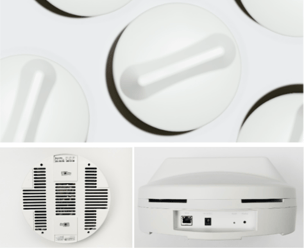
Bastille provides a fully networked system of sensors that actively detects cellular signals, Bluetooth signals, BLE signals, Wi-Fi signals, and IoT device signals. By utilizing multiple sensors working in unison, Bastille accurately pinpoints the location of each detected device. This capability enables Bastille to determine whether a signal above the threshold level originates from one phone inside your facility or ten phones just outside the building, which is crucial for minimizing "false positives" in your application.
Bastille logs detections and their locations, displaying each on a floor map of your facility. Additionally, it captures up to 150 different fields of data about each device. Modern transmitters emit extensive information about themselves and their networks, which proves valuable during investigations of unauthorized devices.
One challenge that Bastille effectively addresses, unlike its competitors, involves the nature of cellular signals. While Bluetooth and Wi-Fi protocols are relatively "chatty," cellular protocols are not. Carriers invest billions in cellular spectrum, leading their 4G and 5G protocols to use this spectrum judiciously. For instance, an iPhone not actively used can go up to 9.5 minutes between transmissions. Consequently, a live iPhone may not be detected by a single sensor during that time. Bastille overcomes this issue by strategically placing sensors throughout protected areas. If an active iPhone passes through the lobby without transmitting, it will still be detected when it pings nine minutes later inside the building.
Many organizations aim to exclude unauthorized devices while allowing certain devices essential for business operations. By tracking numerous fields about each device, Bastille builds a fingerprint of authorized devices and avoids triggering alerts for those that are permitted.

Cost: Yorkie-Pro price vs Bastille
The Yorkie-Pro price is competitively priced as a handheld scanner. Bastille, is potentially a higher in cost, it offers expansive coverage, integration with other components of the security infrastructure e.g SIEMS, security management platforms (Lenel OnGuard, Genetec, etc), video camera and VMS systems, and is therefore suitable for larger organizations.
Reviews
Diving into Yorkie-Pro reviews and Bastille's feedback from customers, both products have their champions. Users on Amazon and other platforms highlight the Yorkie-Pro's reliability as the best cell phone detector for limited local use. Meanwhile, Bastille receives praise for its comprehensive detection capabilities and integrative approach to organizational security.
Best Cell Phone Detector
The question remains: Is there a device that can detect cell phones effectively for your specific needs? Between Yorkie-Pro' and Bastille's solutions, the answer depends on your unique requirements. If you need accurate individual cell phone and device/network detection, with zero false positives, throughout your facility, including the need to detect cellular, bluetooth, BLE, Wi-Fi, and IoT protocols, and a solution that recognizes and allows authorized personal and medical devices, and keeps a detailed audit/log trail, then likely Bastille is better for you. If you need a handheld scanner Yorkie-Pro is a worthy consideration.
Conclusion
Choosing between Yorkie-Pro and Bastille comes down to understanding your cell phone detection needs. Yorkie-Pro is a handheld device, whereas Bastille is a full enterprise solution.
Request a Bastille Demo